Impact wrenches and powered ratchet wrenches have transformed the way professionals and serious home mechanics approach fastener removal and installation. A task that once demanded significant physical effort and time, such as removing seized lug nuts from a vehicle that has been on the road for several winters, can now be completed in seconds with the right impact tool. But the market offers an overwhelming array of options: air driven pneumatic models, cordless battery platforms, different drive sizes, ratchet wrenches versus impact wrenches, and competing claims about torque outputs that are difficult to compare without understanding what the numbers actually mean in use.
The direct answers to the core selection questions are these: an air impact wrench delivers the highest sustained torque and the best torque to weight ratio of any wrench format, making it the professional workshop standard wherever a compressor is available; a battery powered cordless impact wrench provides genuine portability and competitive torque for automotive, construction, and maintenance work without a tethering hose; a 1/2 inch drive is the correct choice for high load applications including wheel fasteners, suspension components, and heavy industrial bolting; and a 3/8 inch drive, particularly in the long head portable cordless ratchet format, is the right tool for engine bay work, confined space access, and medium torque fasteners where a smaller and slimmer tool profile is essential for access and control. This article covers all of these distinctions fully, with the engineering data and practical guidance to make a confident, well informed selection.
What Is an Air Impact Wrench and How Does It Differ from Other Wrenches?
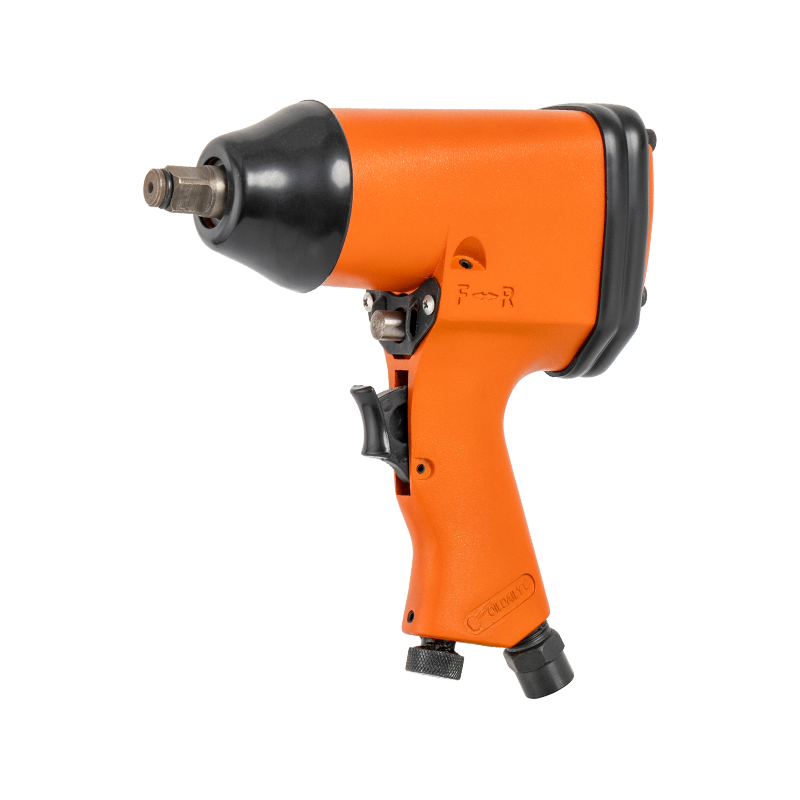
An air impact wrench is a pneumatically powered tool that uses compressed air to drive a rotary impact mechanism, delivering high torque fastener rotation through rapid, intermittent impact strikes rather than through continuous rotational force. It is fundamentally different from a standard socket wrench, a torque wrench, and even an electric drill driver in how it transfers energy to the fastener. The term impact refers specifically to the hammering action at the heart of the tool: a rotating hammer mass repeatedly strikes an anvil to produce short bursts of extremely high rotational force, rather than applying a steady twisting force to the fastener as a manual wrench does.
This distinction matters practically because the impact mechanism allows the tool to break loose fasteners that have been corroded, over tightened, or seized through years of service at torque levels that would be physically impossible with a manual wrench of any reasonable length, and without transmitting the reaction torque to the operator's hands and wrists. A 700 Newton meter manual torque wrench would require a lever arm of over 1.4 meters at 50 kilograms of applied force, and would twist the operator's wrists dangerously if the fastener were to suddenly break free. The impact wrench delivers equivalent or greater energy to the fastener through its impact mechanism while the operator simply holds the tool in position, making high torque fastener work both practical and safe for extended periods.
Air Impact Wrench vs Drill Driver vs Torque Wrench
Many users initially confuse these tool categories or underestimate the distinction between them:
- Drill driver: Applies continuous rotational torque at a relatively low force level, suitable for driving screws and drilling holes but not for removing high torque fasteners. Drill drivers typically deliver 30 to 100 Newton meters of torque continuously, with no impact mechanism.
- Impact driver: Uses an axial impact mechanism (strikes along the axis of rotation) to drive screws and small fasteners at higher torque than a drill driver. Typically delivers 150 to 350 Newton meters but is designed for screw and small bolt driving, not for socket wrench applications. The round hex shank drive is not compatible with standard sockets.
- Impact wrench: Uses a rotary impact mechanism with a square drive anvil compatible with standard sockets. Designed specifically for high torque fastener removal and installation, delivering 200 to 1,500 Newton meters depending on size and power source. The correct tool for nuts, bolts, and lug fasteners from M8 upward in challenging applications.
- Torque wrench: A precision calibration tool designed to tighten fasteners to a specific, controlled torque value. Used after an impact wrench or ratchet wrench has run a fastener on, to ensure the final installation torque meets the specification without over tightening. Not a removal tool and not an impact tool.
How Does an Air Impact Wrench Work: The Pneumatic Mechanism in Detail
Understanding exactly how an air impact wrench converts compressed air into the rotational impacts that drive and remove fasteners helps clarify both why the tool is so effective and what its operational requirements are in terms of air supply. The mechanism is more sophisticated than it might appear from the outside, and the quality of its engineering has a direct bearing on the tool's durability, efficiency, and torque output over its working life.
Step One: The Pneumatic Motor
When the trigger of an air impact wrench is depressed, compressed air from the supply hose enters the tool body and is directed into a pneumatic vane motor. This motor consists of a cylindrical rotor with multiple spring loaded vanes that slide radially within slots in the rotor body. As compressed air enters the motor housing, it pushes against the vane faces, causing the rotor to spin at speeds typically ranging from 7,000 to 12,000 revolutions per minute under no load conditions. The air is then exhausted through ports in the motor body after completing its expansion, typically exiting through the rear handle or side vents of the tool.
The efficiency of the pneumatic vane motor depends critically on the air supply pressure at the tool inlet, not merely at the compressor outlet. Most professional air impact wrenches are designed for operation at 90 PSI (6.2 bar) measured at the tool's air inlet fitting. A pressure drop across a long air hose, undersized fittings, or an inadequate regulator setting between the compressor outlet and the tool inlet can reduce the effective operating pressure significantly, with a corresponding reduction in motor speed and torque output. Pressure losses of 10 to 15 PSI across a typical workshop air line are common, meaning a compressor set to 100 PSI may be delivering only 85 to 90 PSI at the tool.
Step Two: The Hammer and Anvil Impact Mechanism
The high speed rotation of the pneumatic motor is not transmitted directly to the socket drive. Instead, it drives a hammer and anvil mechanism that converts the continuous motor rotation into the characteristic rapid impact strikes of the tool. The most common design is the twin hammer (or dual hammer) mechanism used in quality professional impact wrenches, though single hammer and pin clutch designs are also used in various tool formats.
In the twin hammer design, the motor drives a cam plate connected to two hammer lobes. As the cam rotates, spring tension holds the hammers in engagement with the anvil lugs during light load rotation, allowing the motor to spin the anvil (and therefore the socket and fastener) continuously at high speed. When the fastener load increases beyond the spring's holding force, the cam causes the hammer lobes to disengage from the anvil, spring back under motor energy storage, and then re engage with a sharp impact strike. This cycle of disengagement, acceleration, and re engagement occurs 1,000 to 3,200 times per minute in modern professional grade impact wrenches, with each strike delivering a peak rotational force impulse that can be five to ten times the nominal rated torque of the tool. This is why a wrench rated at 700 Newton meters can routinely break loose fasteners that were installed at torques above that value: the peak impact force during each strike substantially exceeds the steady state torque rating.
Step Three: The Square Drive Anvil and Socket
The anvil that receives the hammer strikes is the component that the socket fits onto. Its square cross section (most commonly 1/2 inch or 3/8 inch drive) accepts standard impact rated sockets, which are then held in place by a spring loaded retainer ball or pin in the anvil's detent groove. The design of the anvil, including its material hardness, heat treatment, and geometry at the hammer contact points, is one of the key factors that determines the durability and torque transmission efficiency of the impact wrench mechanism over thousands of hours of service.
Torque Rating Explained: Breaking Torque vs Fastening Torque
Impact wrench specifications typically list multiple torque figures that must be understood to compare tools meaningfully:
- Maximum fastening torque (also called forward torque or working torque): The maximum torque the tool can apply when driving a fastener on. This is the figure most relevant to installation applications and is the value against which socket specifications and fastener torque requirements are compared.
- Nut busting or breakaway torque: The maximum torque the tool can apply in reverse when removing a fastener. This value is typically 20 to 40 percent higher than the fastening torque in quality impact wrenches, because the impact mechanism can store more rotational energy for the initial breakaway strike that must overcome static friction before the fastener begins to move.
- Rated working torque: Some manufacturers provide a lower continuous working torque figure that represents the torque the tool maintains reliably across extended use, which is more conservative than the peak fastening torque achievable in brief bursts. For professional procurement, the rated working torque is the more useful specification for establishing whether the tool meets application requirements reliably.
What Size Air Compressor Do You Need for an Air Impact Wrench?
The air compressor that powers an impact wrench must meet two distinct requirements simultaneously: it must deliver air at the correct pressure (typically 90 PSI at the tool inlet), and it must supply air at a sufficient flow rate (measured in CFM, cubic feet per minute, or L/min, liters per minute) to keep pace with the tool's air consumption during use. Meeting only the pressure requirement without adequate flow will cause the compressor reservoir to deplete rapidly during use, allowing pressure to fall and tool performance to degrade. Understanding both specifications is essential to setting up a reliable pneumatic tool system.
Air Consumption by Impact Wrench Drive Size and Power Class
The following guidance covers the air consumption requirements for the main categories of air impact wrench used in automotive and industrial applications:
- 3/8 inch drive compact air impact wrenches: Air consumption of 3 to 5 CFM (85 to 142 liters per minute) at 90 PSI. A compressor with a free air delivery (FAD) of at least 5 CFM at 90 PSI is comfortable for sustained use of a 3/8 inch air impact wrench without significant pressure recovery waiting periods between operations.
- 1/2 inch drive standard torque air impact wrenches: Air consumption of 4 to 7 CFM (113 to 198 liters per minute) at 90 PSI. A compressor rated at 6 to 8 CFM FAD at 90 PSI provides adequate supply for this class of tool in continuous automotive workshop use.
- 1/2 inch drive high torque professional air impact wrenches: Air consumption can reach 8 to 14 CFM (227 to 396 liters per minute) during heavy bolt breaking operations. These tools require a compressor with a minimum FAD of 10 to 14 CFM at 90 PSI, typically necessitating a motor of 3 horsepower or larger with a tank of 50 liters or more to avoid excessive on/off cycling.
- Pneumatic ratchet wrenches (3/8 and 1/2 inch): Ratchet wrenches are lighter duty than impact wrenches and typically consume only 2 to 4 CFM at 90 PSI, making them compatible with smaller compressors and allowing use in environments where compressor capacity is more limited.
Compressor Sizing Recommendations by Use Case
Home garage and DIY use (intermittent, 1 to 3 wheel changes per session): A 1.5 to 2 horsepower oil lubricated reciprocating compressor with a 24 to 50 liter tank and a FAD of 5 to 7 CFM at 90 PSI is adequate for a standard 1/2 inch air impact wrench used intermittently. The compressor will need periodic recovery time between extended use sessions, but for most home mechanic tasks, this is acceptable.
Small professional shop (4 to 6 wheel changes per hour, continuous use): A 3 horsepower oil lubricated compressor with a 100 liter tank and a FAD of 9 to 12 CFM at 90 PSI provides comfortable continuous supply for a standard 1/2 inch professional air impact wrench without running the risk of reservoir depletion during a sustained work session.
High volume professional shop (multiple tools running simultaneously): Each additional air impact wrench running simultaneously adds its individual CFM requirement to the total demand. A shop running three 1/2 inch air impact wrenches simultaneously at 6 CFM each requires a compressor system capable of delivering at least 18 to 22 CFM at 90 PSI, typically achieved with a 5 to 7.5 horsepower industrial compressor or multiple smaller compressors feeding a common manifold and storage tank of 200 liters or above.
Air Hose Selection and Its Effect on Tool Performance
Even with an adequately sized compressor, the air delivery system between the compressor and the tool affects the pressure available at the tool inlet. Key factors in air hose selection are:
- Hose internal diameter: A minimum internal diameter of 10 mm (3/8 inch bore) is recommended for impact wrench air supply hoses. Smaller bore hoses create higher flow resistance that drops the pressure at the tool inlet below the compressor outlet pressure, reducing tool performance. For high torque professional wrenches consuming above 10 CFM, a 12 mm (1/2 inch bore) hose is preferred.
- Hose length: Pressure loss across a hose increases with length. A 10 meter hose with a 10 mm bore causes a pressure drop of approximately 3 to 5 PSI at the flow rates of a standard 1/2 inch impact wrench. A 20 meter hose doubles this loss. For long runs, increase the hose bore diameter to compensate, or run the air line at higher regulated pressure to offset the drop.
- Coupling and fitting bore: Undersized quick connect couplings are a common bottleneck in workshop air supply systems. Standard 1/4 inch NPT quick connect fittings have a restricted internal bore that limits flow to approximately 5 to 7 CFM regardless of the hose size used. For high torque air impact wrenches consuming above 8 CFM, use large bore industrial couplings (3/8 inch NPT or larger) throughout the system from regulator to tool.
Electric vs Pneumatic Impact Wrench: A Complete Comparison
The choice between an electric (cordless battery) and a pneumatic impact wrench is one of the most significant decisions in workshop tool investment, because both the initial cost and the ongoing operational experience differ substantially between the two approaches. Modern brushless motor technology in high voltage cordless platforms has narrowed the performance gap that previously gave pneumatic tools a clear advantage, but the two categories remain genuinely different in their strengths and limitations.
Battery vs Air Impact Wrench: Performance and Practical Differences
| Comparison Factor |
Pneumatic Air Impact Wrench |
Cordless Battery Impact Wrench |
| Peak torque (1/2 inch drive) |
Up to 1,500 Newton meters (professional models) |
Up to 1,200 to 1,300 Newton meters (premium 18V brushless) |
| Sustained torque consistency |
Consistent while air pressure is maintained at specification |
Consistent with full battery; reduces gradually as battery depletes |
| Portability |
Restricted by air hose; limited to compressor proximity |
Fully portable anywhere with a charged battery |
| Tool weight (body only) |
1.5 to 2.2 kg (lighter without battery) |
2.2 to 3.5 kg (heavier with battery pack included) |
| Continuous use duration |
Unlimited with adequate compressor |
30 to 90 minutes per charge depending on usage intensity |
| Initial system investment |
High: requires compressor, hose, and fittings in addition to tool |
Medium: tool and battery only; no ancillary infrastructure |
| Noise level |
Very high: tool exhaust and compressor combined (95 to 110 dB) |
High: tool only (85 to 95 dB); no compressor noise |
| Maintenance requirements |
Regular oiling of pneumatic motor; moisture trap maintenance |
Minimal; brushless motor is essentially maintenance free |
| Best working environment |
Fixed professional workshop with installed compressor |
Mobile, field, roadside, construction, and home garage use |
The Ongoing Performance Gap at the Highest Torque Level
While the best cordless impact wrenches from leading manufacturers have closed the gap to pneumatic tools substantially for standard automotive applications, a meaningful performance difference remains at the highest torque levels. Professional grade pneumatic impact wrenches for commercial vehicle and industrial applications routinely deliver 1,000 to 1,500 Newton meters of fastening torque and over 2,000 Newton meters of breakaway torque on large bolt sizes. Even the most powerful 18V and 20V cordless impact wrenches on the market achieve a maximum of around 1,200 to 1,300 Newton meters in peak mode, and this peak is available only briefly at the beginning of the impact sequence with a fully charged battery before power delivery settles to a lower sustained level. For heavy commercial vehicle wheel bolts, large structural fasteners, and industrial bolting applications where sustained high torque is the requirement rather than a brief peak, pneumatic tools retain a genuine operational advantage.
Corded Electric Impact Wrenches: A Third Option
Corded mains powered electric impact wrenches occupy a middle ground between pneumatic and cordless battery tools. They provide unlimited run time (no battery depletion) without requiring a compressor, and deliver sustained torque levels of 600 to 900 Newton meters that are adequate for most passenger vehicle and light commercial vehicle applications. Their limitation is the power cord, which restricts working radius to the length of the cord and an extension lead, and the higher weight of the corded tool body compared to equivalent cordless models. For a home garage user who works in a fixed location and does not want to invest in a compressor, a corded electric impact wrench can be a cost effective midpoint option.
Torque Wrench 1/2 vs 3/8 Inch Drive: Choosing the Right Drive Size
The drive size of an impact wrench or powered ratchet wrench is more than a matter of socket compatibility. It is a structural specification that determines the torque capacity of the square drive connection, the range of socket sizes the tool can efficiently use, and the physical size and weight of the tool itself. Choosing the correct drive size requires matching the tool's drive capacity to both the torque requirements of the application and the physical constraints of the working environment.
1/2 Inch Drive: Power for High Load Fastener Work
The 1/2 inch drive is the standard choice for the highest torque fastening applications in automotive, construction, and industrial maintenance. The 1/2 inch square cross section provides the structural strength to transmit torques up to 1,500 Newton meters or more without failure at the drive connection, and the wide availability of 1/2 inch drive impact sockets from 10 mm through to 50 mm and above makes it the most versatile drive size for heavy fastener work. Applications that properly call for a 1/2 inch drive tool include:
- Passenger car wheel nuts and lug bolts: Specified installation torques of 100 to 160 Newton meters, with seized or corroded fasteners often requiring removal torques of 300 Newton meters or more. All automotive wheel fastener work is correctly performed with a 1/2 inch drive impact wrench.
- Light commercial and heavy vehicle wheel fasteners: Torque specifications of 250 to 600 Newton meters for light commercial vehicles and up to 900 Newton meters for heavy truck wheel nuts demand a 1/2 inch drive as the minimum adequate drive size, with 3/4 inch drive used for the largest commercial vehicle fasteners.
- Suspension, steering, and drivetrain components: Ball joint nuts, tie rod ends, control arm bolts, hub carrier fasteners, and differential cover bolts typically specified at 80 to 250 Newton meters are all correctly worked with a 1/2 inch drive impact wrench.
- Industrial and structural bolting: M16 to M30 structural steel bolts, foundation bolts, and machinery mounting fasteners with torque specifications of 200 to 1,000 Newton meters require the drive capacity and torque output of a 1/2 inch or larger drive impact wrench for efficient installation and removal.
3/8 Inch Drive: Precision, Access, and Medium Torque Efficiency
The 3/8 inch drive is the preferred choice for the broad range of medium torque fastener work that comprises the majority of work in engine bays, body panels, electrical systems, and general mechanical assembly. The smaller drive size allows the tool to be built more compactly and with a slimmer profile, which is directly relevant to access in confined working spaces. Additionally, the 3/8 inch drive provides a more precise torque feel at the moderate torque ranges (20 to 150 Newton meters) typical of engine and chassis fasteners, reducing the risk of over tightening smaller fasteners that would be at risk from the full power of a 1/2 inch impact wrench operating without careful control.
- Engine bay and under hood fasteners (M6 to M14): Cylinder head cover bolts, intake manifold bolts, accessory bracket fasteners, alternator and power steering pump bolts, and oil sump drain plugs are all in the 15 to 80 Newton meter range, ideally suited to a 3/8 inch drive impact tool that combines adequate power with a compact body that fits into tight engine bay locations.
- Brake system components: Caliper guide pin bolts (25 to 45 Newton meters), caliper bracket bolts (70 to 120 Newton meters), and brake disc retaining screws are all comfortably within 3/8 inch drive territory, and the smaller impact wrench or ratchet wrench in this drive size maneuvers more easily within wheel arches than a 1/2 inch tool.
- Interior, electrical, and trim fasteners: Seat belt bolt assemblies (typically 35 to 45 Newton meters), battery terminal clamp bolts, and various interior mounting fasteners are all 3/8 inch drive applications where the smaller tool causes less risk of collateral damage to adjacent components.
Pneumatic Ratchet Wrench: How It Works and When to Use It
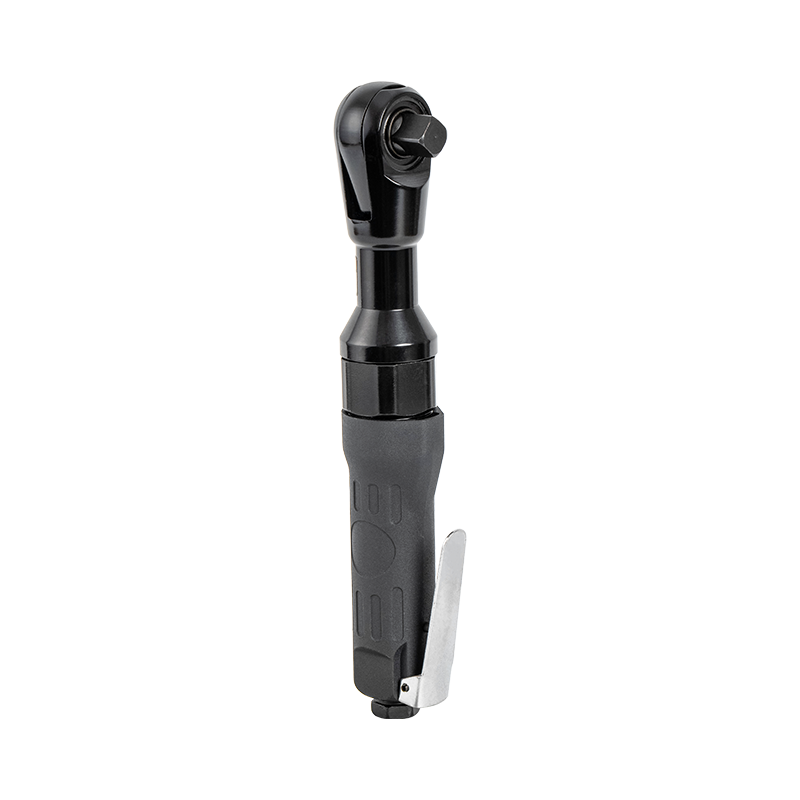
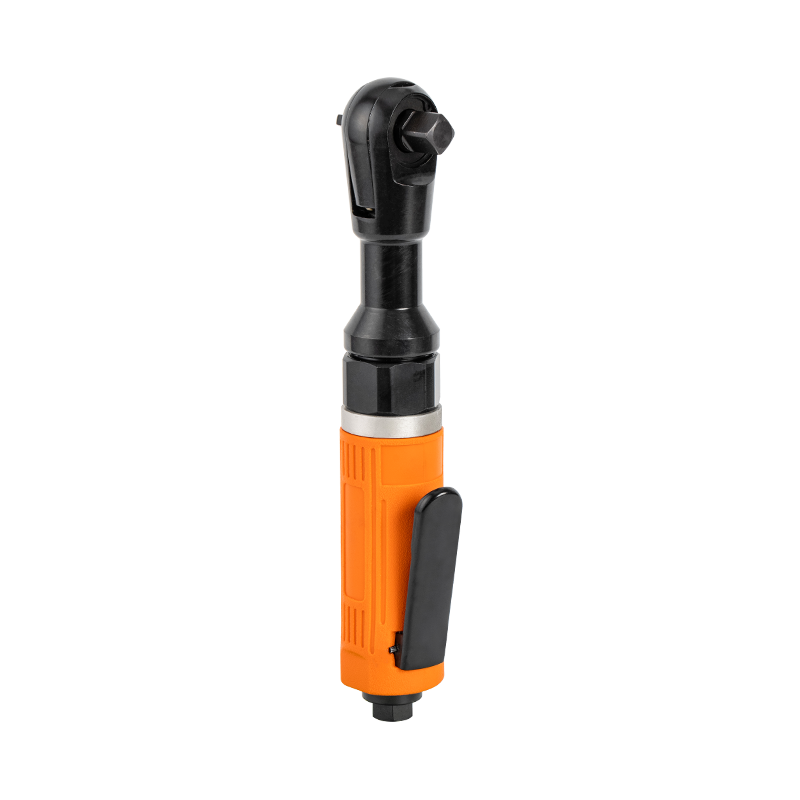
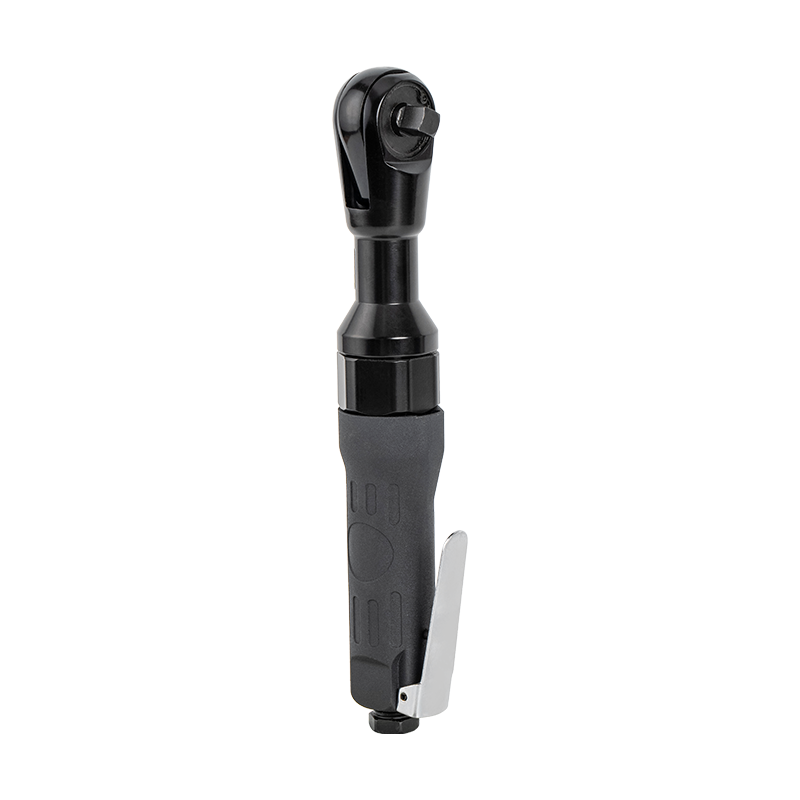
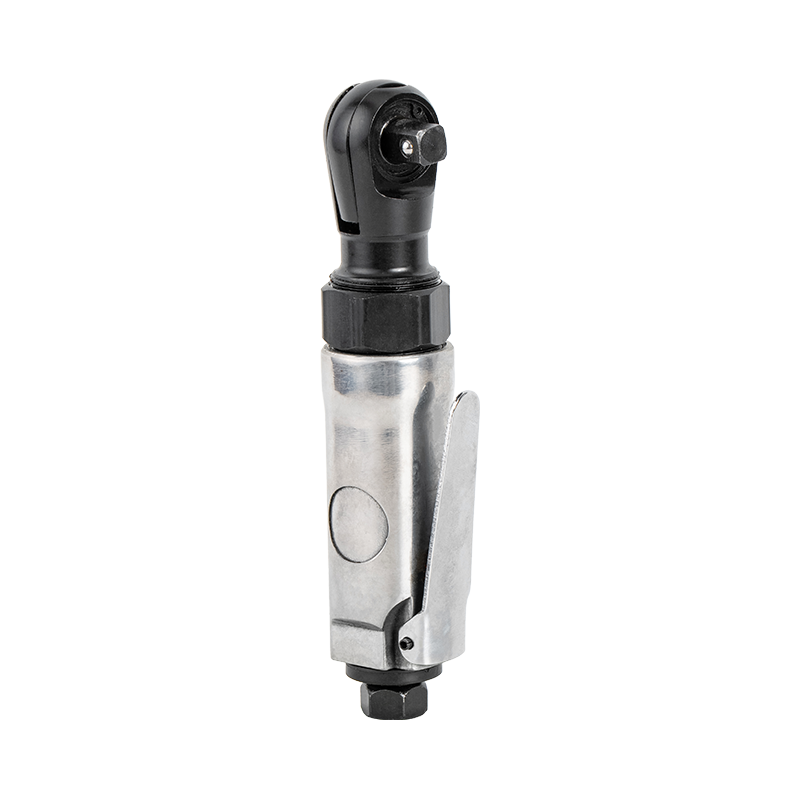
The pneumatic ratchet wrench is a distinct tool category from the impact wrench, though both are air powered and both accept standard sockets. Where an impact wrench delivers torque through rapid hammer strikes, a pneumatic ratchet wrench delivers continuous, smooth rotational torque through a ratchet mechanism driven by the compressed air motor, in exactly the same manner as a manual ratchet but many times faster. This continuous rotation, rather than impact action, makes the pneumatic ratchet wrench suitable for a different range of tasks than the impact wrench, and the two tools are genuinely complementary rather than interchangeable in a well equipped workshop.
A pneumatic ratchet wrench typically delivers 60 to 100 Newton meters of continuous torque at speeds of 150 to 250 RPM, which is the ideal range for rapidly running nuts and bolts on and off threads before final torque tightening with an impact wrench or a torque wrench. The smooth, non impact action makes it gentler on delicate fasteners, thread inserts, and components adjacent to the fastener being worked, and its slim, low profile head allows it to reach fasteners in spaces where neither an impact wrench nor a hand ratchet would fit comfortably.
Pneumatic Ratchet vs Impact Wrench: When Each Is the Right Tool
The distinction between when to use a pneumatic ratchet and when to use an impact wrench is straightforward in practice:
- Use the pneumatic ratchet for: running many fasteners rapidly in volume assembly or disassembly work (such as removing all the bolts from an engine cover or removing multiple caliper bolts across an axle set); working in confined spaces where the low profile head and smooth continuous rotation provide access and control; and pre tightening or running fasteners to a moderate snug torque before final torque wrench tightening.
- Use the impact wrench for: breaking loose seized, corroded, or high torque fasteners that a ratchet cannot shift; driving high torque fasteners such as wheel nuts, structural bolts, and suspension components to their installation torque in minimum time; and any application where the fastener torque requirement exceeds 100 Newton meters consistently.
1/2 Inch High Torque Electric Ratchet Wrench: Bridging the Gap
The 1/2 inch high torque electric ratchet wrench represents a relatively recent development in the powered hand tool market, occupying a functional space between a standard powered ratchet wrench and a light impact wrench. It delivers continuous rotational torque at 1/2 inch drive in the range of 80 to 180 Newton meters, which covers the majority of passenger vehicle fastener torque specifications without the impact shock loading that an impact wrench applies to the fastener and adjacent components. This makes it particularly valuable for fastening tasks where precise torque control matters and the impact wrench's hammering action could damage sensitive or precisely machined components.
Practical applications for the 1/2 inch high torque electric ratchet include pre running wheel nuts before final torque wrench tightening (saving time on high thread count stud patterns), removing and installing transmission drain plugs and fill plugs (typically 40 to 80 Newton meters), and working on suspension components where the fastener access is adequate but the torque requirement exceeds what a standard 3/8 inch ratchet can handle comfortably. The continuous rotation action of the electric ratchet, combined with its 1/2 inch drive torque capacity, makes it a faster and less fatiguing alternative to a 1/2 inch manual ratchet handle for any task involving multiple moderate torque fasteners at 1/2 inch drive sizes.
3/8 Inch Long Head Portable Cordless Electric Ratchet Wrench: The Access Specialist
The 3/8 inch long head portable cordless electric ratchet wrench has become one of the most valued tools in modern automotive and industrial maintenance precisely because it solves an access problem that no other tool addresses as effectively. The extended head profile of the long head design positions the 3/8 inch drive square well ahead of the tool body, allowing the wrench to reach fasteners recessed behind components, buried in engine bay cavities, and positioned at angles or depths that would require partial disassembly of the vehicle to reach with any other tool format.
A well specified 3/8 inch long head cordless electric ratchet in a 12V or 18V platform typically delivers 60 to 90 Newton meters of continuous torque with a head extension that places the drive 40 to 60 mm further from the tool body than a standard ratchet head design. This head extension is not merely a dimensional convenience: it is the enabling factor for accessing fasteners behind timing covers, within recessed valve covers, in the lower regions of engine bays obscured by subframes and exhaust systems, and in under vehicle locations where clearance is insufficient for even a compact impact wrench to operate.
Key Access Applications for the Long Head Format
The specific working scenarios where the 3/8 inch long head cordless electric ratchet delivers access advantages over alternatives include:
- Alternator and tensioner bolts: These fasteners are routinely located in deep recesses of the engine bay, surrounded by belt routing, coolant pipes, and structural brackets. The long head ratchet can reach and run these bolts at a productive speed that would require many individual hand ratchet strokes to replicate, saving significant time on any alternator replacement or belt service job.
- Subframe and crossmember bolts: Under vehicle subframe bolts are often recessed within the subframe geometry in a way that prevents direct socket wrench access from any but the correct axial angle. A long head ratchet that can be positioned at an angle and still clear the surrounding structure is often the only powered tool that works in these locations without component removal.
- Starter motor and ring gear housing bolts: Starter motor fasteners on many modern vehicles are obscured by the transmission bellhousing, subframe, and exhaust heat shields in a way that makes access from beneath the vehicle extremely difficult. The combination of the long head's reach and the cordless tool's portability (working below a vehicle without a hose to manage) makes this one of the most appreciated applications of the format.
- Seat belt and interior anchor bolts: Seat belt lower anchor bolts are typically recessed under trim panels or seat runners in confined positions. The long head ratchet reaches these with the tool held at an angle that no standard ratchet profile could accommodate without removing the trim surrounding the bolt.
Battery Platform Compatibility and Its Practical Importance
For any mechanic or technician who already uses a specific battery platform for their cordless drill, circular saw, or other tools, choosing a 3/8 inch long head electric ratchet from the same manufacturer's platform means the same battery packs can be shared across the tool collection. This battery platform compatibility is a significant practical and financial consideration: a premium 4Ah battery pack can cost 60 to 120 USD, and owning a collection of tools all sharing the same batteries reduces the total battery investment and the charge management complexity significantly compared to maintaining multiple incompatible battery ecosystems. Leading battery platforms from major manufacturers (18V and 20V MAX systems) offer 3/8 inch cordless ratchets as part of their extended tool range, and selecting tools within a single platform is a sound purchasing strategy for any workshop with multiple cordless tool needs.
Application Reference Guide: Matching Tool to Task
The following table provides a practical reference for selecting the most appropriate tool from among air impact wrench, cordless impact wrench, pneumatic ratchet, 1/2 inch high torque electric ratchet, and 3/8 inch long head cordless ratchet for the most common automotive and industrial fastening applications.
| Application |
Recommended Tool |
Drive Size |
Torque Requirement |
Key Reason |
| Passenger car wheel nuts |
Air or cordless impact wrench |
1/2 inch |
100 to 200 Nm |
Speed and torque for lug fasteners |
| Commercial vehicle wheel nuts |
High torque air impact wrench |
1/2 inch or 3/4 inch |
400 to 600 Nm |
Sustained high torque beyond cordless range |
| Engine bay bolts (M8 to M14) |
3/8 inch cordless ratchet or impact |
3/8 inch |
20 to 100 Nm |
Compact size for tight engine bay access |
| Confined space recessed fasteners |
3/8 inch long head cordless ratchet |
3/8 inch |
Up to 80 Nm |
Extended head reaches recessed locations |
| Suspension and chassis bolts |
1/2 inch cordless or air impact wrench |
1/2 inch |
80 to 300 Nm |
Drive capacity for structural fastener torques |
| Volume assembly and disassembly |
Pneumatic ratchet wrench |
3/8 or 1/2 inch |
40 to 100 Nm |
Smooth continuous rotation for rapid fastener running |
| Pre tightening before torque wrench |
1/2 inch high torque electric ratchet |
1/2 inch |
80 to 150 Nm |
Controlled torque without impact shock on sensitive fasteners |
| Industrial structural bolting |
High torque air impact wrench |
1/2 inch or larger |
200 to 1,000 Nm |
Sustained high torque for M20 and above fasteners |
Critical Safety Rules for All Impact and Ratchet Wrench Use
Safe and effective use of any powered impact or ratchet wrench requires consistent attention to the following practices:
- Always use impact rated sockets with impact wrenches. Standard chrome hand tool sockets are manufactured to a different material and wall thickness specification than impact sockets and are not designed to withstand the shock loading of an impact wrench's hammer mechanism. They can crack or shatter under impact use, with fragments ejected at high velocity. Impact sockets are distinguished by their black oxide finish, thicker walls, and chamfered internal geometry.
- Never use an impact wrench as a final torque control tool on critical fasteners. Wheel nuts, cylinder head bolts, bearing hub fasteners, and other safety critical fasteners must be torqued to their manufacturer specified value using a calibrated torque wrench after the impact wrench has been used to run the fastener to a snug position. Impact wrenches routinely under torque or over torque fasteners relative to specification when used without a separate torque verification step.
- Inspect air fittings and hoses before each session of pneumatic tool use. A pressurized air fitting that fails releases the hose end with dangerous force. Check all quick connect couplings, hose end fittings, and whip checks for security, wear, and cracking before connecting the air supply, and never use a hose or fitting that shows visible damage or corrosion.
- Use ear protection when operating pneumatic impact wrenches. Air impact wrenches operating in enclosed workshop environments regularly produce noise levels of 95 to 110 decibels, well above the 85 decibel threshold at which cumulative hearing damage begins with sustained exposure. Hearing protection is not optional for regular users of pneumatic impact tools.
- Match tool torque output to the fastener size being worked. Using a high torque 1/2 inch impact wrench on small M6 or M8 fasteners risks stripping threads, shearing bolt heads, or cracking delicate components such as plastic housings and alloy castings. Use the smallest tool adequate for the job, and use the lowest torque setting available when working on smaller fasteners with a variable torque tool.



 عربى
عربى 中文简体
中文简体 By Admin
 Address: Jiangbei District Ningbo City in Zhejiang Province by the Keli industrial ParkL Building 15th
 Phone: +86-139 0668 0779
 Tel: +86-139 0668 0779
 Fax: +86-139 0668 0779
 E-mail:[email protected]

