Purpose, Differences, and Which Tool You Actually Need
The purpose of the air impact wrench is to deliver high-torque rotational force to fasteners through a series of rapid hammer blows driven by compressed air, enabling the fast tightening or loosening of bolts and nuts that would be extremely slow or physically impossible with a standard hand wrench. It is the dominant power tool in automotive repair, heavy equipment maintenance, construction, and industrial assembly because it combines exceptional torque output with speed and reduced operator fatigue.
In the air impact wrench vs electric impact wrench comparison, the practical verdict is: choose an air impact wrench when you have access to a reliable compressed air supply and need maximum torque output at the lowest possible tool weight for sustained high-volume work; choose an electric impact wrench when cordless freedom of movement, simpler setup, or precision torque control are the primary requirements. Neither type is universally superior. The right tool depends on your work environment, the fastener sizes you work with most, and whether a compressor is already part of your shop infrastructure.
On calibration: torque wrenches used in safety-critical applications should be calibrated every 12 months or every 5,000 cycles, whichever comes first, per ISO 6789 and most professional workshop standards. Air impact wrenches themselves do not have calibration requirements in the same sense, but their torque output should be verified periodically if they are used in applications where final torque values matter.
What Is the Purpose of the Air Impact Wrench: Core Function and Industrial Value
The air impact wrench solves a fundamental physical problem in mechanical work: fasteners that are corroded, overtightened, or installed under high stress require more torque to break free than a human can comfortably generate with a hand tool over a full working day. The purpose of the air impact wrench is to provide that torque consistently and repeatedly without fatiguing the operator.
The Hammer and Anvil Mechanism: How Air Impact Wrenches Generate Torque
Unlike a drill or screwdriver that transmits torque continuously through a rotating shaft, an air impact wrench uses a hammer and anvil mechanism that delivers torque in a series of rapid rotational impacts. The internal mechanism works as follows:
- Compressed air enters the motor and drives a rotor at high speed (typically 8,000 to 20,000 RPM with no load).
- The rotor drives a hammer assembly that accumulates rotational kinetic energy.
- The hammer assembly releases this accumulated energy in a sudden rotational impact against the anvil (the square output drive that connects to the socket).
- The anvil transmits this impact torque to the fastener through the socket.
- The hammer releases, reloads, and delivers the next impact, typically at rates of 1,200 to 2,000 impacts per minute (IPM).
This impact mechanism is what makes air impact wrenches so effective at breaking loose stuck fasteners. Each impact delivers a brief but intense torque pulse that exceeds the continuous resistance of the fastener's static friction. A typical professional air impact wrench delivers maximum torque values of 300 to 1,500 Nm in impact mode, compared to the 20 to 50 Nm that a human operator can sustain with a standard ratchet wrench over extended work periods.
Primary Applications Where Air Impact Wrenches Are Indispensable
- Automotive tire service: Removing and installing wheel lug nuts on passenger cars, trucks, and commercial vehicles. A tire shop technician using an air impact wrench can complete a four-wheel tire change in 10 to 15 minutes; the same job with hand tools takes 45 to 60 minutes. High-volume tire shops process 30 to 60 tire changes per day, making the time saving commercially critical.
- Engine and drivetrain work: Removing seized cylinder head bolts, suspension components, exhaust manifold fasteners, and differential cover bolts that require torque exceeding hand tool capability.
- Construction and structural steel: Installing and removing high-strength structural bolts in steel frame construction. Torque requirements for M30 structural bolts can exceed 2,000 Nm, which is only achievable with high-torque pneumatic tools or specialized hydraulic wrenches.
- Mining and heavy equipment maintenance: Servicing bulldozers, excavators, mining trucks, and processing plant equipment where fastener sizes and torque requirements far exceed automotive scales.
- Oil and gas pipeline construction: Assembling flanged pipe joints and pressure vessel connections where both high torque and speed are required across large numbers of identical fastener assemblies.
What Are the Different Types of Air Impact Wrenches: A Complete Classification
The question of what are the different types of air impact wrenches is most usefully answered by considering three classification systems simultaneously: drive size, body style, and mechanism type. Understanding all three allows buyers and users to select the correct tool for their specific application rather than defaulting to the most common general-purpose option.
Classification by Drive Size
Drive size refers to the square output drive on the anvil that accepts sockets. This is the most fundamental specification because it determines the range of fastener sizes the tool can work with and the maximum torque it is designed to deliver:
- 1/4 inch drive: The smallest commercial size, designed for small fasteners typically from M4 to M10 (metric) or 1/4 to 3/8 inch (imperial). Maximum torque output typically 40 to 100 Nm. Used in electronics assembly, light automotive trim work, and precision mechanical work where limited torque is needed to avoid fastener damage.
- 3/8 inch drive: A versatile mid-size drive for passenger car work, light truck maintenance, and general mechanical applications. Maximum torque output typically 100 to 300 Nm. The preferred size for underbody car work where the wrench must fit into confined spaces while still handling most fasteners encountered in passenger vehicle maintenance.
- 1/2 inch drive: The most widely used air impact wrench size globally, covering the full range of passenger car and light truck fasteners including lug nuts, suspension components, and engine fasteners. Maximum torque output typically 300 to 1,100 Nm. The standard tool in professional automotive workshops, general industrial maintenance, and construction.
- 3/4 inch drive: Heavy-duty size for large trucks, agricultural equipment, construction machinery, and industrial applications. Maximum torque output typically 1,000 to 2,500 Nm. Significantly heavier than 1/2 inch drive tools, making sustained use more physically demanding.
- 1 inch drive: High-torque industrial tool for heavy equipment, mining machinery, and large structural applications. Maximum torque output typically 2,000 to 5,000 Nm. Almost exclusively used in industrial and heavy construction environments rather than automotive workshops.
Classification by Body Style
Body style determines the ergonomics, access capability, and best working positions for the tool:
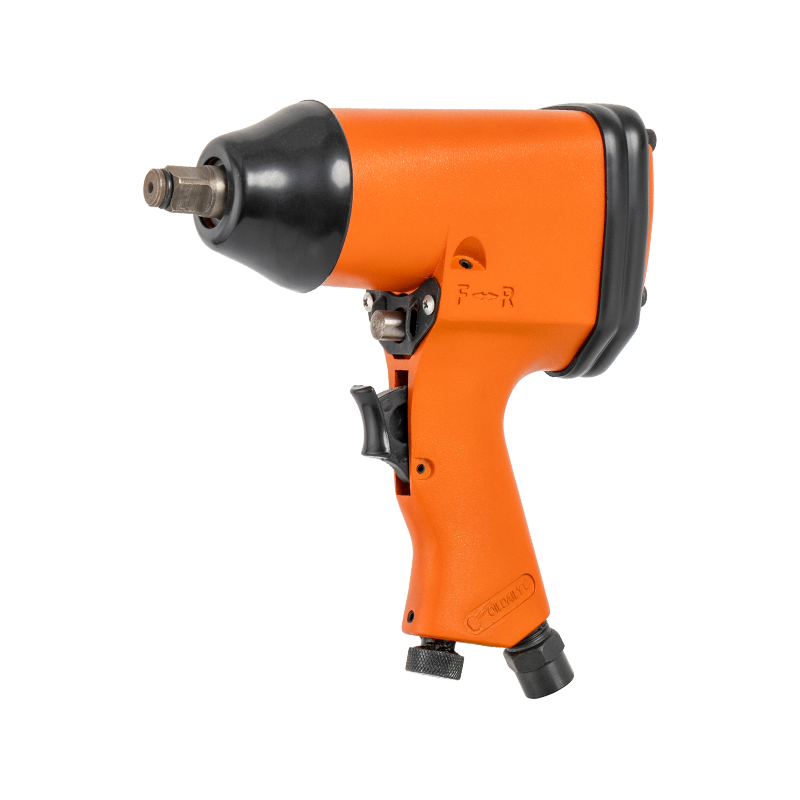
- Standard (pistol grip) body: The classic air impact wrench shape with a D-shaped handle below the motor housing. The most widely produced and purchased body style. Best for straightforward vertical access to fasteners (overhead, floor level) and for users who prefer a two-handed grip for high-torque applications. The pistol grip body provides the best leverage and control when maximum torque is applied, because the handle is in line with the torque reaction force.
- Inline (straight body): Motor, hammer mechanism, and drive are all in a straight line with the handle at the rear. The inline body provides access to fasteners in confined spaces where the pistol grip body would not fit, such as inside wheel arches, between frame members, and in narrow engine compartments. Maximum torque output is typically lower than equivalent pistol grip models because the inline geometry limits the hammer mechanism size that can be accommodated in the housing.
- Angle body: The drive is at a 90-degree angle to the motor axis. Designed for extreme confined-space access where neither pistol grip nor inline bodies can reach the fastener. Lower torque output than straight body tools of equivalent size, but essential for specific automotive and aerospace applications where access geometry leaves no alternative.
Classification by Hammer Mechanism Type
The internal hammer mechanism determines the torque delivery character, power-to-weight ratio, and durability of the air impact wrench:
- Single hammer mechanism: A single hammer element strikes the anvil once per rotation. Simple and robust, but produces higher vibration levels than twin-hammer designs and delivers less smooth torque output. Common in budget and mid-range tools.
- Twin hammer mechanism: Two hammer elements positioned 180 degrees apart strike the anvil in rapid succession. The twin-hammer design delivers twice the impact frequency for the same rotor speed compared to single-hammer designs, producing a smoother torque output, lower vibration, and better performance in tight spaces where the higher impact frequency allows the tool to work through the fastener's resistance more progressively. Professional-grade air impact wrenches from Ingersoll Rand, Chicago Pneumatic, and Snap-on predominantly use twin-hammer mechanisms for their superior smoothness and reduced vibration compared to single-hammer alternatives.
- Pin clutch mechanism: A unique internal design that provides adjustable torque output through a pin and cam system. Pin clutch mechanisms are used in precision assembly applications where final torque must be controlled to a target value without additional calibration tools, though the accuracy of pin clutch torque control is lower than a calibrated torque wrench and should not be relied upon for safety-critical applications.
Types of Air Impact Wrenches: Summary Comparison
| Drive Size |
Max Torque (Nm) |
Typical Weight (kg) |
Air Consumption (CFM) |
Primary Application |
| 1/4 inch |
40 to 100 |
0.6 to 1.0 |
2 to 4 |
Electronics, light trim work |
| 3/8 inch |
100 to 300 |
1.0 to 1.5 |
4 to 6 |
Passenger car underbody work |
| 1/2 inch |
300 to 1,100 |
1.8 to 2.5 |
4 to 7 |
Automotive, light industrial |
| 3/4 inch |
1,000 to 2,500 |
4.0 to 7.0 |
8 to 14 |
Heavy trucks, construction machinery |
| 1 inch |
2,000 to 5,000 |
8.0 to 15.0 |
15 to 25 |
Mining, heavy industrial |
Types of air impact wrenches by drive size with typical torque output, weight, air consumption, and primary applications
Air Impact Wrench vs Electric Impact Wrench: A Complete Practical Comparison
The air impact wrench vs electric impact wrench debate is one of the most practically relevant tool selection questions for professional mechanics, construction workers, and industrial maintenance teams. Both technologies are capable, mature, and widely used, but they have fundamentally different strength profiles that make each type distinctly better suited to certain operating environments and use cases.
Air Impact Wrench Advantages Over Electric
- Superior power-to-weight ratio: Air-powered impact mechanisms deliver more torque per kilogram of tool weight than equivalent electric motors. A professional 1/2 inch air impact wrench weighing 1.8 kg typically delivers 600 to 700 Nm of maximum torque. An equivalent cordless electric impact wrench delivering the same torque typically weighs 2.5 to 3.5 kg including battery, because the brushless motor, transmission, and lithium-ion battery pack add significantly more mass than the air motor and hammer mechanism they replace.
- Continuous duty operation without thermal limitation: Air impact wrenches can run continuously without the thermal buildup that limits electric motor operation at maximum torque. In a high-volume tire shop processing 60 vehicles per day, an air impact wrench runs nearly continuously; an equivalent electric tool would require periodic cooling breaks or would throttle its output to prevent motor overheating.
- Lower long-term operating cost in high-volume shops: A professional-grade air impact wrench costing USD 200 to USD 400 and powered by an existing shop compressor has a total cost per fastener cycle significantly lower than cordless electric alternatives where battery replacement every 2 to 4 years at USD 80 to USD 150 per pack adds substantially to the lifetime operating cost.
- Tolerance of harsh environments: Air impact wrenches have fewer sensitive electronic components than brushless electric impact wrenches, making them more tolerant of extreme heat, cold, contamination with oil and metallic debris, and the physical abuse of a busy automotive workshop floor.
Electric Impact Wrench Advantages Over Air
- Portability without compressed air infrastructure: Cordless electric impact wrenches work anywhere without needing a compressor, hose, or air supply. This advantage is decisive in roadside breakdown assistance, field service work, construction sites without established compressed air infrastructure, and home garages where installing a compressor is impractical.
- Precision torque control in modern brushless models: Premium cordless electric impact wrenches from Makita, Milwaukee, and DeWalt now include multi-stage torque control with precise output settings that allow the user to set a target torque level that the tool will not exceed. This electronic torque control is genuinely useful for assembly applications where fasteners must be tightened to a specific torque without a follow-up torque wrench check. Air impact wrenches offer only basic torque adjustment through airflow regulation, which is inherently less precise.
- Lower noise output: Cordless electric impact wrenches typically produce 90 to 100 dB(A) of noise during operation. Air impact wrenches produce 95 to 115 dB(A), with the additional noise contribution from the compressed air exhaust that vents through the handle during operation. In noise-regulated workshop environments and in customer-facing settings where excessive tool noise would create a poor impression, the quieter operation of electric alternatives is a meaningful advantage.
- No compressor investment required: Setting up a compressed air system capable of running professional-grade air impact wrenches continuously requires a two-stage reciprocating or rotary screw compressor with a minimum capacity of 4 to 7 CFM at 90 PSI per wrench in use simultaneously. A properly sized compressor, air dryer, piping, and pressure regulators represent a capital investment of USD 1,500 to USD 10,000 or more depending on shop size. For small shops, individual operators, or home users, avoiding this infrastructure cost is a significant financial advantage of electric alternatives.
Air Impact Wrench vs Electric Impact Wrench: Side-by-Side Comparison
| Criterion |
Air Impact Wrench |
Electric Impact Wrench |
Advantage |
| Max torque per kg tool weight |
250 to 400 Nm/kg |
150 to 250 Nm/kg |
Air |
| Continuous duty capability |
Unlimited (with air supply) |
Limited by battery and heat |
Air |
| Portability (no compressor needed) |
No (compressor required) |
Yes (cordless models) |
Electric |
| Noise level during operation |
95 to 115 dB(A) |
90 to 100 dB(A) |
Electric |
| Torque precision and control |
Basic (air pressure regulation) |
High (electronic control) |
Electric |
| Upfront infrastructure cost |
High (compressor required) |
Low |
Electric |
| Long-term cost (high volume) |
Lower |
Higher (battery replacement) |
Air |
| Environmental tolerance |
Excellent |
Good but less robust |
Air |
Air impact wrench vs electric impact wrench direct comparison across key performance and operational criteria
What Are the Key Features of an Air Impact Wrench: Buying Guide for Professionals
The question of what are the key features of an air impact wrench is most practically answered in the context of a purchase decision, because different features have different value depending on the application. Understanding which features genuinely matter for your use case prevents overspending on capabilities you will not use or underspending on a tool that lacks the performance needed for your work.
Maximum Torque and Torque in Loosening vs Tightening Mode
Maximum torque output is the primary specification parameter for any air impact wrench, but buyers must understand the difference between maximum torque in loosening mode (also called breakaway torque) and maximum torque in tightening mode. Most professional air impact wrenches deliver 30% to 50% more torque in loosening direction than in tightening direction, because the internal hammer mechanism is configured asymmetrically to maximize the force available to break loose stuck fasteners while limiting the tightening torque to reduce the risk of overtightening and fastener damage.
When comparing specifications between brands and models, always compare the tightening torque figures for tightening applications and the loosening torque figures for removal applications. A tool specified at 1,200 Nm maximum loosening torque but only 700 Nm maximum tightening torque is a different tool performance profile than one specified at 900 Nm in both directions.
Free Speed and Impacts Per Minute
Free speed (RPM) indicates how fast the output drive rotates with no load applied. Higher free speed enables faster run-down of fasteners (the rotation phase before the socket engages the fastener head fully and the hammer mechanism takes over). A fast run-down speed is commercially important in high-volume settings like tire shops where every second saved per fastener across 60 vehicles per day compounds into significant productivity gain.
Impacts per minute (IPM) is a measure of how frequently the hammer delivers impact blows to the anvil. Higher IPM at equivalent torque per impact produces a smoother, more progressive torque delivery that reduces the shock felt by the operator and reduces the risk of fastener head damage from a large discrete impact. Professional-grade air impact wrenches typically deliver 1,200 to 2,400 IPM, with twin-hammer mechanisms generally achieving higher IPM values than single-hammer equivalents of similar size.
Air Consumption and Operating Pressure Requirements
Air consumption (measured in CFM, cubic feet per minute, or L/min) and required operating pressure (measured in PSI or bar) are critical specifications for matching the tool to the available compressor capacity. Connecting an air impact wrench to a compressor with insufficient capacity results in pressure drop during operation, reduced torque output, and inconsistent performance that compromises both productivity and quality.
Most professional 1/2 inch drive air impact wrenches require 4 to 6 CFM at 90 PSI for sustained operation. For a shop running three simultaneous wrenches, the compressor must supply at least 18 CFM at 90 PSI continuously. Adding a 25% margin for hose pressure losses and compressor efficiency gives a minimum compressor specification of approximately 22 to 24 CFM for this example. Operating an air impact wrench at below its specified minimum pressure consistently reduces maximum torque output by 15% to 30% per 10 PSI below specification, which is a common and easily overlooked cause of stubborn fasteners appearing to resist removal when the tool is actually simply underpowered by an inadequate air supply.
Torque Control Mechanism
Air impact wrenches offer various levels of torque control to allow the user to adjust the tool's output to suit the fastener size and torque requirement:
- Trigger throttle control: The simplest form of torque control, where varying trigger depression reduces airflow and therefore reduces torque output. Not precise enough for torque-critical applications but adequate for general removal and installation of non-critical fasteners.
- Adjustable torque regulator: A mechanical regulator on the body of the tool (often a rotary selector with 4 to 10 positions) that limits maximum air flow to the motor at each setting. More repeatable than trigger throttle control but still not as precise as a calibrated torque wrench for safety-critical applications.
- Shut-off clutch (for precision assembly tools): Advanced assembly-grade air impact wrenches include a clutch mechanism that disengages the drive when a preset torque level is reached. These tools are used in production line assembly where consistent fastener torque is required across large numbers of identical assemblies. Not commonly found in general-purpose workshop tools.
Ergonomic and Durability Features
Ergonomic features of an air impact wrench significantly affect operator fatigue and long-term health outcomes in professional use:
- Anti-vibration handle design: Vibration transmitted from the hammer mechanism through the handle is a significant occupational health concern. Prolonged exposure to hand-arm vibration (HAV) can cause Hand-Arm Vibration Syndrome (HAVS), a progressive condition affecting circulation and sensation in the hands. Premium air impact wrenches include vibration-dampening handle materials and internal counterweights that reduce transmitted vibration. The EU Physical Agents Directive 2002/44/EC sets a daily vibration exposure action value of 2.5 m/s² and a limit value of 5.0 m/s², and employers are required to manage workers' vibration exposure against these limits.
- Composite housing vs metal housing: Composite (glass-fiber-reinforced polymer) housings are lighter than aluminum or steel housings, reducing the total weight the operator must support during extended use. Metal housings provide more impact damage resistance. Professional users in automotive workshops generally prefer composite housing for its weight advantage; heavy industrial users often prefer metal housing for its durability under rougher site conditions.
- Rear exhaust vs side exhaust: Air exhausted from the motor must vent somewhere, and the vent direction affects operator comfort and the risk of blowing debris into the work area. Rear exhaust vents air away from the work and the operator's hands. Side exhaust can direct air across the work surface, which can be useful for blowing away debris around a fastener but can also blow contamination into the operator's face if the tool is oriented unfavorably.
What Are the Safety Precautions for Using an Air Impact Wrench
The question of what are the safety precautions for using an air impact wrench is critically important because the tool's high torque output, noise level, and use of compressed air create specific hazards that are absent when using hand tools. The following precautions are required for safe professional use and should be communicated and enforced in any workplace where air impact wrenches are routinely used.
Personal Protective Equipment Requirements
- Hearing protection: Air impact wrenches operating at 95 to 115 dB(A) require hearing protection whenever the tool is in use. At 100 dB(A) continuous exposure, the US OSHA permissible exposure limit (PEL) of 90 dB(A) for an 8-hour day is exceeded in just 2 hours without protection. Earmuffs or earplugs with an appropriate noise reduction rating (NRR) for the tool's operating noise level must be worn. Hearing loss from excessive noise exposure is permanent and cumulative, making consistent hearing protection use in air impact wrench environments one of the most important long-term health behaviors for professional mechanics.
- Eye protection: Safety glasses or goggles must be worn when using an air impact wrench, because the impact mechanism can loosen corroded fasteners with enough force to eject metal fragments, rust particles, and socket lubricant spray at high velocity. The exhaust air stream also carries fine particulate matter that can cause eye injury if directed toward the face.
- Gloves (with caution): Anti-vibration gloves reduce transmitted vibration and protect hands from cuts on sharp metal edges. However, gloves can reduce the operator's grip strength and tactile feedback, which may increase the risk of losing control of the tool if it kicks back unexpectedly. Use gloves that provide vibration attenuation without significantly reducing grip capability.
Tool and Air Supply Safety Practices
- Never use oxygen or any gas other than air: Air impact wrenches must only be operated with compressed air. Using any other compressed gas including oxygen, nitrogen, or carbon dioxide creates the risk of tool pressurization beyond the design rating, explosive failure, or in the case of oxygen, the creation of a fire and explosion hazard from the combination of pressurized oxygen with any oil contamination in the air line or tool.
- Verify air supply pressure before connecting: Check that the supply pressure does not exceed the maximum rated pressure of the tool, which is typically 90 to 120 PSI depending on the model. Overpressure can cause internal component failure and creates a higher risk of socket ejection under the increased impact energy delivered at elevated pressure.
- Use impact-rated sockets and accessories only: Standard chrome-vanadium hand tool sockets are not designed to withstand the rapid impact loads of an air impact wrench. Using non-impact-rated sockets with an air impact wrench creates the risk of catastrophic socket failure, which can result in fragment ejection that causes severe injury. Impact-rated sockets are manufactured from chromium-molybdenum steel with a specific heat treatment that provides controlled deformation under impact loading rather than brittle fracture. They are identified by their black oxide coating (versus the chrome finish of hand tool sockets) and by the ANSI/ASME or ISO impact socket designation on their packaging.
- Inspect the tool and hose before each use: Check the air hose for cracks, kinks, and degraded fittings that could cause sudden disconnection under pressure. Check the tool's retaining pin or ring that secures the socket to the drive to ensure it is intact. A socket that detaches from the tool during operation becomes an uncontrolled projectile with significant injury potential.
- Never point the air exhaust at other people: The exhaust air from an air impact wrench carries contamination from the tool internals and can cause eye or skin injury at close range. Keep the tool oriented so that the exhaust vents away from other workers and bystanders in the work area.
Operational Safety Practices
- Secure the workpiece before applying torque: The reaction torque from an air impact wrench is transmitted to the workpiece as well as the fastener. If the vehicle, component, or assembly being fastened is not properly secured, the reaction torque can cause unexpected movement. Ensure vehicles are on a stable lift or jack stands and that components being disassembled are properly supported before applying the wrench.
- Use the correct torque setting for the fastener: Operating at full torque on small fasteners (M6 to M10) risks stripping the fastener, breaking it, or pulling threads from a tapped hole. Use the tool's torque control setting to reduce output when working with smaller fasteners, and verify the appropriate torque setting before applying the tool.
- Disconnect from air supply when changing sockets: Depressurize the tool by releasing the trigger with the drive pointed in a safe direction before changing sockets. Never change sockets while the tool is connected to an air supply and the trigger is accessible, because accidental trigger activation can cause the socket to fly off the drive or the tool to rotate unexpectedly during the socket change.
- Conduct final torque verification with a calibrated torque wrench for critical fasteners: Air impact wrenches are not precision torque tools. For any fastener where torque is safety-critical (wheel lug nuts, suspension fasteners, brake calipers, cylinder head bolts), the air impact wrench should be used only to run the fastener down to near-seated, and a calibrated torque wrench used for the final tightening to specification. This is standard practice in professional automotive workshops and aerospace maintenance facilities.
How Often Should Torque Wrenches Be Calibrated: Standards and Practical Guidance
The question of how often should torque wrenches be calibrated is important in any professional context where fastener torque is safety-critical. Torque wrenches are precision measuring instruments, and like all precision instruments they can drift from their calibrated accuracy over time due to use, overloading, impact damage, temperature cycling, and normal material fatigue in the spring or beam mechanism.
ISO 6789 Calibration Requirements for Torque Tools
ISO 6789 is the international standard governing the design, testing, and calibration of hand torque tools including click-type, beam-type, and dial-type torque wrenches. Under ISO 6789:2017, a torque wrench must be capable of achieving the torque output within plus or minus 4% of the setting throughout its full scale range (for indicating-type wrenches) or within plus or minus 4% of the actual torque applied (for setting-type click wrenches).
ISO 6789 does not prescribe a specific recalibration interval in calendar terms, but instead requires recalibration after defined numbers of uses and after specific events that may have affected the wrench accuracy. Most professional organizations and national calibration standards bodies interpret the ISO 6789 requirements in the context of practical calibration management as follows:
- Annual calibration for regularly used wrenches: A torque wrench used daily or several times per week in a professional workshop should be calibrated at intervals not exceeding 12 months, regardless of the number of uses during that period. This recommendation appears in ASME B107.300 (the US equivalent of ISO 6789) and is widely adopted in automotive, aerospace, and industrial maintenance quality systems.
- 5,000 cycle recalibration threshold: ISO 6789 specifically recommends recalibration after 5,000 measurement cycles (uses), regardless of the calendar interval since last calibration. In a high-volume tire shop where a torque wrench may be used 100 to 200 times per day for lug nut final torque verification, this means the wrench may reach 5,000 cycles in as little as 25 to 50 working days, requiring calibration approximately every 6 to 8 weeks in this specific use pattern.
- Immediate recalibration after overloading: Any torque wrench that has been used to apply torque beyond 20% of its maximum rated capacity, or that has been dropped from a height above table level onto a hard floor, should be immediately removed from service and sent for recalibration before further use. Impact damage and overloading can permanently shift the wrench's calibration by changing the spring rate of the click mechanism or the elastic modulus of the beam.
- Aerospace and safety-critical standards (NASA-STD-8739.4, ASME B107.300): In aerospace assembly and nuclear industries, torque wrench calibration intervals are typically reduced to 6 months or 2,500 cycles for click-type wrenches used on flight-critical or safety-critical fasteners, reflecting the higher consequences of calibration drift in these applications.
Practical Calibration Management for Professional Workshops
Implementing effective torque wrench calibration management in a professional workshop involves more than just sending tools for periodic calibration. Best practice includes:
- Calibration stickers and records: Every calibrated torque wrench should carry a visible calibration sticker showing the calibration date, the due date for next calibration, and the calibration certificate number. Maintain a tool register that tracks all calibrated tools, their calibration history, and upcoming calibration due dates.
- Accredited calibration laboratories: Calibration performed for safety-critical applications should be conducted by a laboratory accredited to ISO/IEC 17025, which is the international standard for testing and calibration laboratory competence. Accredited calibration provides traceability to national measurement standards and a calibration certificate that verifies the wrench's accuracy against a known reference standard within stated measurement uncertainties.
- Correct wrench storage: Store click-type torque wrenches at their minimum scale setting (not at the torque value of the last use) to prevent the click spring from taking a set at a compressed length, which progressively shifts the click threshold downward. Wrenches stored correctly at minimum scale consistently maintain their calibration longer between calibration intervals.
Frequently Asked Questions
1. What is the purpose of the air impact wrench in a professional setting?
The purpose of the air impact wrench is to deliver high-torque rotational force to fasteners through rapid hammer blows powered by compressed air, enabling the fast tightening and loosening of bolts and nuts that would be too slow or physically impossible with hand tools. In professional settings, the air impact wrench dramatically increases productivity in tasks like tire changing, engine disassembly, and structural steel assembly by delivering 300 to 1,500 Nm or more of torque at rates of 1,200 to 2,400 impacts per minute, compared to the 20 to 50 Nm a human can sustain with a hand ratchet.
2. What are the different types of air impact wrenches and how do I choose the right one?
The different types of air impact wrenches are classified by drive size (1/4 inch, 3/8 inch, 1/2 inch, 3/4 inch, 1 inch), body style (pistol grip, inline, angle), and hammer mechanism (single hammer, twin hammer, pin clutch). Choose 1/2 inch drive for general automotive and light industrial work. Choose 3/8 inch for confined-space passenger car underbody work. Choose 3/4 inch or 1 inch for heavy trucks, construction machinery, and industrial fasteners. Choose inline or angle body style for access-restricted spaces. Choose twin-hammer mechanism for smoother torque delivery and reduced vibration in professional high-volume applications.
3. What are the key features of an air impact wrench that matter most for professional use?
The key features of an air impact wrench for professional use are: maximum torque output in both tightening and loosening directions; impacts per minute (higher IPM provides smoother torque delivery); air consumption and operating pressure requirements matched to the available compressor; torque control mechanism (adjustable regulator for most workshop work, shut-off clutch for precision assembly); tool weight and balance for sustained use comfort; vibration levels and anti-vibration handle features for operator health; and housing material durability appropriate to the work environment.
4. What are the safety precautions for using an air impact wrench?
The safety precautions for using an air impact wrench include: always wear hearing protection (the tool operates at 95 to 115 dB(A)); wear eye protection against ejected debris; use only impact-rated sockets (not standard chrome-vanadium hand tool sockets); verify air supply pressure does not exceed the tool's maximum rated pressure; never use gases other than compressed air; inspect hose and socket retaining ring before each use; secure the workpiece against reaction torque before applying the tool; use the correct torque setting for the fastener size; and always verify final torque on safety-critical fasteners with a calibrated torque wrench rather than relying on the impact wrench output.
5. How often should torque wrenches be calibrated in a professional workshop?
Torque wrenches should be calibrated at intervals not exceeding 12 months for regularly used wrenches in professional workshops, per ISO 6789 and ASME B107.300 recommendations. Additionally, recalibration is required after 5,000 measurement cycles regardless of the calendar interval. In high-volume applications such as tire shops where a wrench may be used 100 to 200 times daily, this cycle-based threshold can be reached in 25 to 50 working days. Immediate recalibration is required after any overloading event (torque applied beyond 120% of the wrench's maximum rated capacity) or after dropping the wrench onto a hard surface.
6. In the air impact wrench vs electric impact wrench comparison, which is better for a home mechanic?
For a home mechanic performing occasional maintenance and repairs without an established compressed air system, a cordless electric impact wrench is generally the more practical choice in the air impact wrench vs electric impact wrench comparison. The electric tool requires no compressor investment, is immediately portable for use anywhere, and modern brushless cordless models deliver sufficient torque (600 to 800 Nm in premium models) for virtually all passenger car work. The air impact wrench becomes the better choice for a home mechanic who already owns a compressor, performs high-volume work, or needs maximum torque output for heavy-duty fasteners beyond the capability of most cordless electric alternatives.
7. Why can't I use my regular chrome sockets with an air impact wrench?
Regular chrome-vanadium hand tool sockets are manufactured to provide smooth, precise fit with hardened fastener heads under the static torque of a ratchet or breaker bar. They are heat-treated for hardness and resistance to wear under static loading but are not designed for the rapid, repeated impact loads of an air impact wrench. Under impact loading, chrome-vanadium sockets can shatter brittle-fracture style, sending high-velocity metal fragments in all directions. Impact-rated sockets are manufactured from chromium-molybdenum steel with a tougher heat treatment that allows controlled deformation rather than brittle fracture under impact. They are easily identified by their black oxide surface finish versus the bright chrome finish of standard sockets.
8. How does air pressure affect air impact wrench performance?
Air pressure directly affects the torque output, speed, and efficiency of an air impact wrench. Most professional air impact wrenches are rated at 90 PSI operating pressure, which is the standard for most shop compressor systems. Operating below this rated pressure reduces torque output approximately 15% to 30% for each 10 PSI below specification. Operating above the rated pressure delivers more torque per impact but risks internal component damage and increases the risk of socket ejection. For consistent performance, maintain supply pressure at the tool's rated pressure at the tool inlet (not just at the compressor outlet) by using adequately sized air lines, quality fittings, and inline regulators at each tool drop point.
9. What are the torque limitations of air impact wrenches for critical automotive fasteners?
Air impact wrenches have inherent torque accuracy limitations that make them unsuitable as the sole tightening method for safety-critical automotive fasteners. The torque output of an air impact wrench varies with air supply pressure, fastener thread friction, socket wear, and hammer mechanism condition, and can vary by 20% to 40% from the operator's intended setting even with the torque regulator adjusted. For wheel lug nuts (typically torqued to 90 to 140 Nm depending on vehicle), brake caliper bolts (typically 30 to 80 Nm), and suspension fasteners, the correct professional practice is to use the air impact wrench to run the fastener down to near-seated and then use a calibrated click-type torque wrench for the final tightening to specification. This two-step process combines the speed advantage of the impact wrench with the accuracy requirement of the calibrated torque wrench.
10. What maintenance does an air impact wrench require to maintain performance and longevity?
Air impact wrenches require the following regular maintenance: daily lubrication by adding 3 to 5 drops of pneumatic tool oil into the air inlet before each day's use (or use an in-line oiler set to 1 drop per minute of operation); weekly inspection of the air intake filter for contamination; monthly inspection of the anvil retaining ring or pin for wear or displacement; regular cleaning of the exterior to prevent corrosive contamination of the housing and control mechanism; and annual disassembly and cleaning of the hammer mechanism with replacement of worn internal components including hammer, anvil, and O-rings as indicated by reduced performance. Using dry or contaminated compressed air without inline filtration and moisture separation is the most common cause of premature air impact wrench wear and failure.



 عربى
عربى 中文简体
中文简体 By Admin
 Address: Jiangbei District Ningbo City in Zhejiang Province by the Keli industrial ParkL Building 15th
 Phone: +86-139 0668 0779
 Tel: +86-139 0668 0779
 Fax: +86-139 0668 0779
 E-mail:[email protected]

